The best expressive text-to-speech platforms in 2026 are ElevenLabs, Voicefinder (Voyager 1), Fish Audio, Cartesia and Inworld if you want to direct the performance with tags or instructions; Google Cloud, Microsoft Azure, MiniMax, xAI and OpenAI for large-scale APIs; Typecast, Murf, Speechify and WellSaid for voiceover studios; Deepgram and Rime for real-time voice agents; Amazon Polly for low-cost volume; and Chatterbox and Kokoro if you want open source. None of them wins everything, and the order changes with what you are making.
Voicefinder is our product. That is why we explain how we ranked the list, say where others are ahead, and only use facts each company publishes on its official website. Data checked on 24 November 2026.
What "expressive" text to speech means
Expressive TTS does more than read cleanly: it performs. It switches emotion halfway through a script, whispers, laughs, lifts the energy on the last line of an ad or slows down for an audiobook, because you asked it to. There are four ways to ask:
- Inline tags such as
[whispers],[laughs]or[excited], which change one sentence. - Natural-language instructions: "speak calmly, like a doctor giving good news".
- Preset styles per voice (promo, newscast, conversational…), often through SSML.
- Voice design or cloning: building the character from a description or a sample.
The basics still matter: names and numbers said right, natural pacing, clean audio and results you can repeat. A realistic voice is all of that together.
How we ranked them
We looked at the list from the point of view of someone producing voiceovers (ads, video, training, audiobooks) and weighed, in this order: how much expressive control you get, how many languages and accents it covers, what it gives you to finish the piece (studio, API, cloning), what it costs to start, and whether it marks audio as synthetic. If you are building real-time voice agents, jump to "How to choose": the order is different there.
Summary table
US dollars, before tax, for the cheapest plan or rate each website publishes. "Not stated" means the official site does not say, not that it does not exist.
| Platform | Best for | Languages | Free plan | Price from |
|---|---|---|---|---|
| 1. ElevenLabs | All-rounder: voiceover, dubbing and agents | 90+ (Eleven v4) | 10,000 credits/month, non-commercial with attribution | $6/month (30,000 credits) |
| 2. Voicefinder (Voyager 1) | Ads and video with sentence-by-sentence direction and regional accents | 55+ | 10,000 characters/month, personal use | $12/month (100,000 characters) |
| 3. Fish Audio | Free-form bracket direction and low-cost cloning | 83 (S2.1-Pro) | 8,000 credits/month | $15/month (Plus) |
| 4. Cartesia | Low-latency voice agents | 44 (Sonic 3.6) | 20,000 credits/month | $5/month (Pro) |
| 5. Inworld | Directable voices in real time | 200+ (per its docs) | Up to 70 min of TTS | $25/month or $25 per 1M characters |
| 6. Google Cloud TTS | Prompt-directed speech at scale | 75+ languages and variants | Monthly free tier (1M–4M characters by voice type) | $4 per 1M characters |
| 7. MiniMax Speech | Emotions and sounds by API, plus voice design | 40 | Not stated | $5/month; API from $60 per 1M |
| 8. Microsoft Azure AI Speech | Enterprises needing many locales and SSML styles | 100+ languages and locales | 0.5M characters/month | $15 per 1M characters |
| 9. xAI (Grok TTS) | A simple API with speech tags | 20 | Not stated | $15 per 1M characters |
| 10. OpenAI TTS | Developers already on OpenAI | Follows Whisper (optimised for English) | Not stated | $15 per 1M characters (tts-1) |
| 11. Typecast | Creators who want emotion inferred from context | 35+ | 3,000 download credits, no commercial use | $5/month (Basic) |
| 12. Murf AI | Corporate training and presentations | 35+ | 10 minutes, no commercial use | $19/month billed annually |
| 13. Speechify | Creator studio, and an API with a generous free tier | 48 (API, Simba 3.5) | Studio: 600 credits; API: 500,000 characters/month | $10/month (API); Studio $100/year |
| 14. WellSaid | Enterprise teams that need licensed voices | 55 languages and accents | No | Custom |
| 15. Deepgram (Flux TTS, Aura-2) | Production voice agents | English + 10 (Flux TTS) | $200 credit | $0.030 per 1,000 characters (Aura-2) |
| 16. Rime | Lowest-latency agents and self-hosting | 10 (Coda, cloud API) | $50 of usage a month | $0.030 per minute (Mist v3) |
| 17. Amazon Polly | Low-cost volume on AWS | No figure given ("dozens of voices") | 5M characters/month on Standard voices | $4 per 1M (Standard) |
| 18. Chatterbox (Resemble AI) | Open source with emotion control | 23+ (Multilingual) | Free (MIT licence) | Free, self-hosted |
| 19. Kokoro | Lightweight, fast open source | 9 language variants | Free (Apache 2.0) | Free, self-hosted |
| 20. Narakeet | Turning slide decks into narrated video | 100 | 20 conversions | $6 for 30 min, no subscription |
1. ElevenLabs
Who it's for: teams that need lots of languages, a mature ecosystem and tools beyond text to speech.
ElevenLabs is the reference point in the category. The Eleven v4 family (v4 and v4 Turbo) covers 90+ languages and is directed with bracketed audio tags such as [whispering], [shouting] or [laughing]; v4 does not support SSML. You can design a voice from a written description, clone instantly from the Starter plan and train a professional clone from Creator. Beyond TTS it offers dubbing, music, sound effects and a conversational agents platform, and it quotes a median latency of about 100 ms for v4 Turbo.
Pricing: Free with 10,000 credits a month, non-commercial and with attribution. Starter $6/month (30,000 credits, commercial licence and instant cloning); Creator $22; Pro $99; Scale $299; Business $990.
Worth knowing: its own pages give different language counts (the pricing table says 74). We compare the two products in detail on our ElevenLabs alternative page.
2. Voicefinder (Voyager 1)
Who it's for: people producing ads, video and training who want to direct the voice sentence by sentence, like an actor, and need a specific accent.
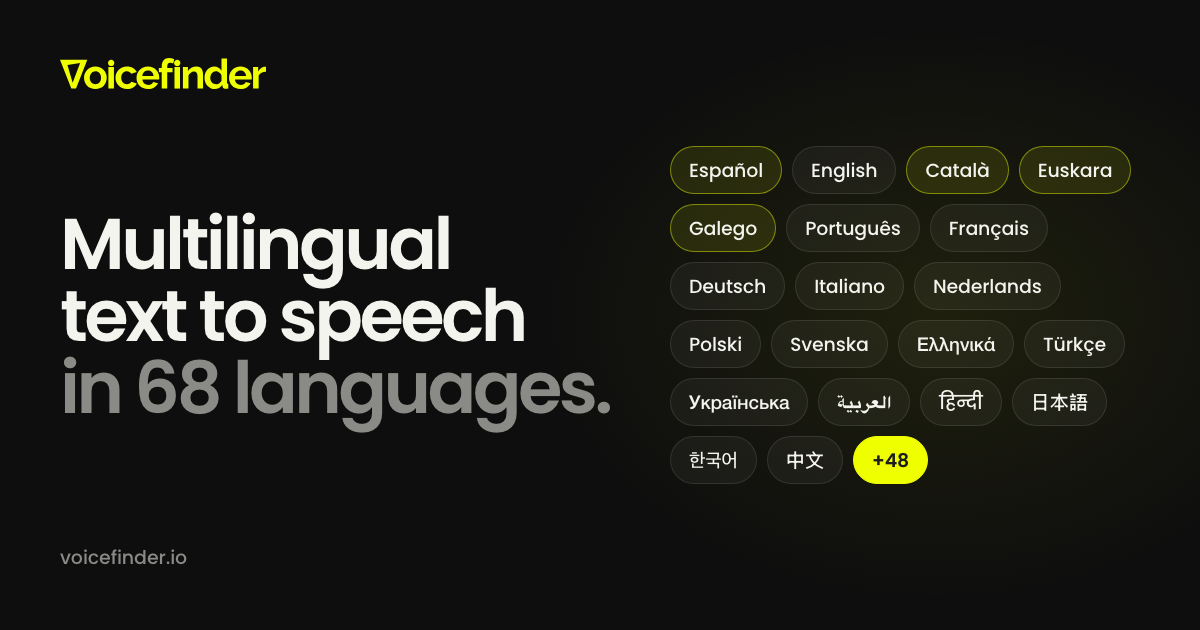
Voyager 1 is Voicefinder's text-to-speech model: 800+ realistic voices in 55+ languages. In English you choose real accents (General American, Southern US, British RP, Northern English, Scottish, Welsh, Irish, Australian and more); in Spanish there are voices from Spain and Latin America, plus native Catalan, Basque and Galician voices. You direct each sentence with emotion tags, set the speed sentence by sentence, and lock how names and brands are said with a pronunciation dictionary.
Every plan delivers 48 kHz audio, and every file carries an AudioSeal watermark and C2PA Content Credentials. You can work in the web studio, through the REST API or with an MCP connector for assistants such as Claude, and there is video dubbing too.
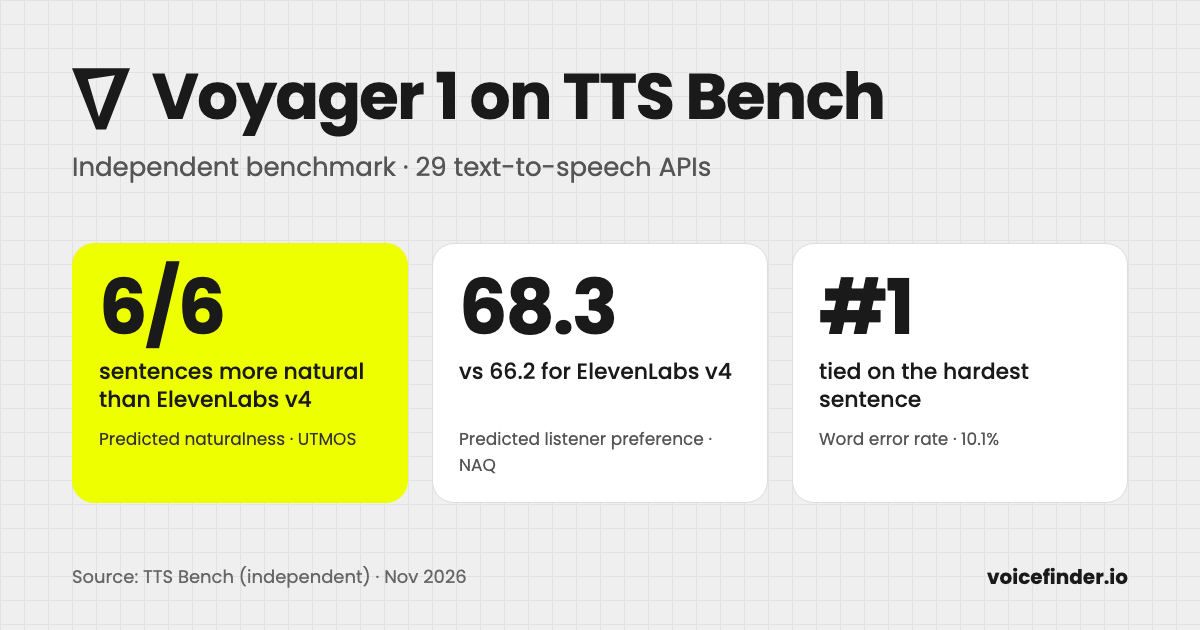
On an independent benchmark: on TTS Bench, Voyager 1 ranked 18th of 29 for naturalness (NAQ), just ahead of ElevenLabs Eleven v4 (19th), and tied for 1st on word error rate on the benchmark's hardest sentence (10.1%). Seventeen models rank above it on NAQ, led by Cartesia.
Pricing: Free with 10,000 characters a month, no card, personal use. Basic $12/month with commercial use. See pricing.
Worth knowing: it does not currently offer real-time TTS for voice agents, it cannot create a voice from a text description, and it covers fewer languages than ElevenLabs, Azure or Google. Why second: sentence-level direction, accent depth and a watermark on every file carry a lot of weight in voiceover work. Hear demos by use case on the best AI voices.
3. Fish Audio
Who it's for: creators who want free-form direction and cheap cloning.
Fish Audio calls itself "the most expressive, emotionally controllable real-time voice model". Its current models are Drama 3 and Live 3 on the web app and S2.1-Pro on the API, with 83 languages. It takes bracketed tags such as [angry], [whispering] or [laughing], and its docs say they are not limited to a fixed set. Cloning needs a short sample (the site mentions 10 to 15 seconds), voice design comes with Plus and above, and its docs describe the S2-Pro model as open source.
Pricing: Free with 8,000 credits a month; Plus at a list price of $15/month (250,000 credits, commercial use); S2.1-Pro API at $15 per million UTF-8 bytes.
Worth knowing: the free plan card and the FAQ on the same page disagree about commercial use, so check before you publish. On TTS Bench, Fish Audio Drama 3 scored higher than Voyager 1 on the French and Spanish sentences. More on our Fish Audio alternative page.
4. Cartesia
Who it's for: teams building voice agents that must answer instantly.
Cartesia presents Sonic 3.6 as its fastest, most natural model: 44 languages and latency under 90 ms. You control emotion, speed and volume with tags (emotion tags are English only), and [laughter] makes the model laugh. It clones a voice from 10 seconds of audio and offers on-prem or VPC deployment through sales. On TTS Bench, Cartesia Sonic 3.6 tops the naturalness (NAQ) board at 86.8.
Pricing: Free with 20,000 credits a month (the commercial licence starts on Pro); Pro $5/month with 100,000 credits; Startup $49; Scale $299.
5. Inworld
Who it's for: conversational products and games that want voices you direct in plain words.
Inworld offers Realtime TTS-2, its flagship, and the faster TTS-2 Flash. You describe the delivery in natural language, it renders 50 non-verbal sounds (such as [laugh] and [sigh]), and it clones a voice from 3 seconds of audio or designs one from a description. It quotes first audio in as little as 50 ms with Flash.
Pricing: free On-Demand plan with up to 70 minutes of TTS; Creator $25/month; API from $25 per 1M characters (TTS-2) or $15 (Flash).
Worth knowing: the product page and the docs give different language counts (about 500 against 200+); we use the docs figure.
6. Google Cloud Text-to-Speech
Who it's for: developers on Google Cloud who want to direct speech with prompts and scale it.
Google Cloud Text-to-Speech lists 380+ voices across 75+ languages and variants. Its Gemini-TTS models let you set style, accent, pace, tone and emotion with text prompts, including multi-speaker output, and accept some markup such as [sigh] (in Preview). Chirp 3 HD voices control pace and pauses. For cloning, Google points to Gemini 3.8 voice replication, in Preview.
Pricing: a monthly free tier of 4M characters on Standard and WaveNet, 1M on Neural2 and up to 1M on Chirp 3 HD (none for Gemini-TTS). After that, $4 per 1M on Standard and WaveNet, $16 on Neural2 and $30 on Chirp 3 HD; Gemini 2.5 Flash TTS is billed per token ($0.50 per 1M input, $10 per 1M audio output).
7. MiniMax Speech
Who it's for: developers who want emotions and sounds as API parameters, with voice design and cloning.
MiniMax offers Speech 2.8 (hd and turbo) with 40 languages and 300+ voices. Through the API you pick an emotion (happy, sad, angry, surprised, calm…), insert sounds like (laughs) or (sighs) and adjust pitch, intensity and timbre. It designs voices from a description and clones from a minimum of 10 seconds of audio.
Pricing: Starter plan at $5/month; API at $60 per 1M characters for speech-2.8-turbo and $100 for speech-2.8-hd; $1.50 per cloned voice.
8. Microsoft Azure AI Speech
Who it's for: enterprises that need many locales, controlled styles and the Microsoft cloud.
Azure AI Speech has neural voices in 100+ languages and locales, at 24 kHz and 48 kHz. HD voices detect emotion in the text and adjust their tone, and styles are requested with SSML (mstts:express-as). Dragon HD Omni voices accept natural-language style descriptions, for now on two US English voices. Custom voice is limited access and needs an application.
Pricing: 0.5M characters free a month on neural voices; then $15 per 1M, or $22 for Neural HD (from Microsoft's official retail prices API).
9. xAI (Grok TTS)
Who it's for: developers who want a straightforward API with performance tags.
The xAI text-to-speech API supports 20 languages and tags such as [pause] and [laugh], or text wrapped in <whisper>. Its custom voices API clones a voice from a short clip. On TTS Bench, xAI ties with Voyager 1 and Fish Audio Drama 3 for 1st place on the hardest sentence.
Pricing: $15 per 1M characters.
10. OpenAI TTS
Who it's for: teams already building on the OpenAI API.
With gpt-4o-mini-tts you steer accent, emotional range, intonation, tone, speed or whispering through instructions ("Speak in a cheerful and positive tone"). Its docs say voices are optimised for English and language support follows Whisper. Its usage policy asks you to tell listeners the voice is AI-generated.
Pricing: tts-1 at $15 per 1M characters; gpt-4o-mini-tts at $0.60 per 1M text input tokens and $12 per 1M audio output tokens.
Worth knowing: OpenAI has announced that tts-1, tts-1-hd and gpt-4o-mini-tts shut down on 6 January 2027, and recommends gpt-realtime-2.1-mini, which runs on its Realtime API.
11. Typecast
Who it's for: video creators who want emotion to follow the script automatically.
Typecast runs on its SSFM models. Smart Emotion reads the surrounding text to shape the delivery, and there are emotion presets too. It lists 35+ languages, instant cloning from 5 seconds of audio and professional cloning from longer recordings, an API, and Zapier, Make and n8n integrations.
Pricing: Free with 3,000 lifetime download credits, no commercial use and attribution required; Basic $5/month with 30,000 download credits and a commercial licence. API from $15/month.
12. Murf AI
Who it's for: L&D and marketing teams producing presentations and corporate video.
Murf has a voiceover studio and the Falcon API. You shape delivery with preset styles (conversational, documentary, promotional, calm…), a pronunciation editor and "Say It My Way", where you record your own read and the voice follows your intonation. It lists 35+ languages, instant and professional cloning, Canva, PowerPoint and Captivate integrations, and under-55 ms model latency for Falcon.
Pricing: Free with 10 minutes, no commercial use; Creator from $19/month billed annually. Falcon API at 1 cent per minute.
13. Speechify (Studio and API)
Who it's for: creators who want voice, dubbing and stock media in one place, and developers who want a large free tier.
Speechify has two products. Studio offers 1,000+ voices, dubbing and a voice changer, and lets you adjust emotion and emphasis. The API runs Simba 3.5, with 48 languages, SSML for pauses, rate, pitch and pronunciation, and cloning on paid plans from a 10–30 second sample with verified consent. It quotes 72 ms to first audio.
Pricing: Studio Free with 600 credits, no commercial use; Studio Starter $100 a year. API free with 500,000 characters a month and commercial use; Starter $10/month.
Worth knowing: its docs say the speechify:style emotion tag was only applied by retired models; current Simba models read the text without that style.
14. WellSaid
Who it's for: large teams that need clearly licensed voices and a review workflow.
WellSaid is a voiceover platform for teams, with 300 licensed voices across 55 languages and accents. Every voice is built from recordings by a professional voice actor who gave consent, and each file carries a licence record. You direct pacing, emphasis and pronunciation line by line with a shared pronunciation library, and its Producer product brings the studio into assistants such as Claude and ChatGPT.
Pricing: no free plan; every plan is custom-scoped.
15. Deepgram (Flux TTS and Aura-2)
Who it's for: production voice agents, deployed in the cloud or on-prem.
Deepgram launched Flux TTS, conversational text to speech that carries tone across turns and handles interruptions without SSML or style tags. It speaks English plus 10 more languages; Aura-2, built for volume, covers 7. It quotes responses from 80 ms and deployment in the cloud, a private cloud or on-prem.
Pricing: $200 free credit; Aura-2 at $0.030 per 1,000 characters and Flux TTS at $0.045.
16. Rime
Who it's for: phone and conversational agents that need minimal latency or must run on their own infrastructure.
Rime offers Coda, its flagship, and Mist v3, its low-latency model. Coda does not support SSML; it accepts short expressive tags such as <giggle> as best-effort cues. Coda's cloud API covers 10 languages. Rime quotes sub-100 ms time to first byte and self-hosting with Docker or Kubernetes.
Pricing: free plan with $50 of usage a month; pay as you go from $0.030 per minute (Mist v3) or $0.050 (Coda).
17. Amazon Polly
Who it's for: AWS applications that need high volume at low cost.
Amazon Polly has Standard, Neural, Long-Form and Generative engines. Expression is controlled with SSML (emphasis, intonation, phrasing and style); there are no emotion tags or natural-language instructions. Voice cloning is enabled for select customers. It can adjust speech duration to help with dubbing.
Pricing: 5M characters free a month on Standard (and 100,000 on Generative for the first 12 months); $4 per 1M on Standard, $16 on Neural and $30 on Generative.
18. Chatterbox (Resemble AI)
Who it's for: developers who want an open model with emotion control and cloning.
Chatterbox is Resemble AI's open-source model family, MIT licensed, with commercial use and self-hosting allowed. Resemble describes it as the first open-source model with emotion exaggeration control. It clones from a 5–20 second reference clip, the Multilingual version supports 23+ languages, and every generation carries a PerTh watermark.
Worth knowing: in August 2026 Resemble AI said it no longer sells voice AI to new customers and is focusing on deepfake detection; Chatterbox stays open and free.
19. Kokoro
Who it's for: anyone who wants a small open model that is cheap to run.
Kokoro-82M is an open-weight model with 82 million parameters and Apache-licensed weights. It ships 54 preset voices across nine language variants: American and British English, Spanish, French, Hindi, Italian, Japanese, Brazilian Portuguese and Mandarin Chinese. It has no emotion tags; its strengths are speed and cost. Install it with pip install kokoro.
20. Narakeet
Who it's for: teachers and trainers turning slide decks into narrated video.
Narakeet turns scripts or slides into narrated video, with 900 voices in 100 languages. Its controls are technical rather than emotional: SSML, emphasis, pauses and speed. It makes the list because it solves one job very well, even though it is the least expressive tool here.
Pricing: 20 free conversions; a 30-minute pack for $6, no subscription.
What about PlayHT, Hume AI and LOVO?
They show up on many older lists, but we can't recommend them today. The PlayHT domain (play.ht) no longer responds. Hume AI's website no longer offers text to speech (Octave) and focuses on audio analysis. LOVO's website did not load on 24 November 2026. If any of them comes back, we will review it.
How to choose by use case
| If you're making… | Look first at | Why |
|---|---|---|
| Ads, radio spots and performance-driven video | Voicefinder, ElevenLabs, Fish Audio | Per-sentence tags, cloning and, on Voicefinder, regional accents |
| E-learning and corporate video | Murf, WellSaid, Voicefinder, Narakeet | Slide integrations, licensed voices, pronunciation dictionaries and steady reads |
| Audiobooks and long-form narration | ElevenLabs, Google Gemini-TTS, Voicefinder, Fish Audio | Multiple speakers, prompt direction and voices that hold up over long texts |
| Real-time voice agents | Cartesia, Deepgram, Inworld, Rime, ElevenLabs | Published latencies of 100 ms or less and, for several, private deployment |
| High-volume API | Google Cloud, Azure, Amazon Polly, xAI, MiniMax | Per-million-character pricing and free tiers |
| Open source | Kokoro, Chatterbox, Fish Audio S2-Pro | Open models you run on your own server |
For a specific English or Spanish accent, or for Catalan, Basque or Galician with emotion, Voicefinder is the most direct option. For real-time agents, today it is not.
How to test them: the same script everywhere
Every vendor picks its own demos. To compare fairly, paste the same script into three or four platforms, first with the default voice and then with a directed one. This one targets what breaks most often:
[calm] On March 14, 2026, Dr. Siobhan Nguyen presented the report in Worcester. [surprised] Did we really grow 37.5%? [whispers] Don't tell anyone yet. [excited] Call us at 1-800-555-0199 and start your free trial today!
Translate the tags into each tool's syntax (some use instructions instead of brackets) and check:
- Numbers, dates and phone numbers: does it say "thirty-seven point five percent" and group the phone number naturally?
- Names and places: does it get "Siobhan" and "Worcester" right?
- Emotion changes: can you hear the shift from calm to surprise, to a whisper, to excitement, or does it all sound the same?
- Consistency: generate three takes. Do they match?
- Real cost: what a minute actually cost, whether tags are billed, and whether the plan allows commercial use.
For an outside reference, TTS Bench runs 29 APIs on the same sentences and publishes the audio.
Try Voyager 1 free: 10,000 characters a month, no card
FAQ
What is the best expressive text-to-speech platform in 2026?
It depends on the job. For an all-rounder with the most languages, ElevenLabs; for directed voiceover with specific accents, Voicefinder; for real-time agents, Cartesia, Deepgram, Inworld or Rime; for API volume, Google Cloud, Azure or Amazon Polly. The most reliable test is running the same script on several.
What's the difference between expressive and neutral TTS?
Neutral TTS reads with correct but constant intonation. Expressive TTS changes emotion, pace and intensity when you ask, through tags, instructions or styles, and can add sounds such as laughs or sighs.
Is there a free plan that allows commercial use?
According to their websites, Speechify's API allows commercial use on its free tier (500,000 characters a month), and Chatterbox and Kokoro are open source under licences that allow it. ElevenLabs, Voicefinder, Typecast, Murf and Speechify Studio keep commercial use for paid plans.
Which open-source option is best?
Kokoro if you want something light and fast (82 million parameters, Apache 2.0); Chatterbox if you need emotion control and cloning (MIT). Fish Audio's docs also describe its S2-Pro model as open source.
How can I tell if audio was made with AI?
Some platforms mark it. Voicefinder adds an AudioSeal watermark and C2PA Content Credentials to every file on every plan; Chatterbox embeds a PerTh watermark; WellSaid attaches a licence record to each file. OpenAI's usage policy asks you to disclose AI voices to listeners.
What happened to PlayHT and Hume AI?
The PlayHT domain no longer responds, and Hume AI's website no longer offers text to speech. If you used them, ElevenLabs, Cartesia and Inworld are alternatives with cloning and expressive control.
Data checked on 24 November 2026 on each platform's official website, linked in its section. Prices change often: confirm them before you buy. TTS Bench results are the ones in our post of 22 November 2026. All names are trademarks of their owners; Voicefinder is not affiliated with them.