The best AI voices for filmmakers are the ones you can direct like an actor: a voice with the right weight for the piece, plus emotion tags and speed to shape each line. In the Voyager 1 library, Ambrose and Clifford are built for movie trailers, Bernard for period and fantasy epics, Gwendolyn and Rosamund for British drama and prestige documentaries, Lillian for thrillers, Beau for westerns and action, Terence and Celeste for factual narration. Every file downloads as a 48 kHz WAV, ready for your timeline.
Below you’ll find each voice with its demo, a table to pick by type of film, and where AI voice actually fits in a production: from the scratch track in your first cut to the Spanish version for a festival.
Try these voices on your next cut →
Where does AI voice fit in a film production?
Not in place of your cast. AI voice earns its place in the gaps where an actor isn’t there yet, isn’t needed, or isn’t in the budget:
- Scratch narration. Cutting to a temp voiceover with real pacing beats reading the script into your phone. When the final read arrives, the edit already breathes in the right places.
- Animatics and pre-vis. An animatic with voices explains itself in a meeting. Without them, you have to explain it.
- Trailers, teasers and pitch reels. The sizzle reel for investors or the video for a grant application needs a voice with weight before there’s money to pay for one.
- Documentary narration. Especially in early cuts, when the narration script changes every screening.
- Foreign-language versions. The same piece in Spanish or French for a festival or a distributor, without rebooking the session.
- Title cards and slates. The voice that says the title, the date or the studio name, where a clean take matters more than a performance.
For your characters’ final dialogue, working with actors is still the norm. If the project needs a professional voice artist, Voicefinder also has a marketplace of professional voice actors you can hire.
The best AI voices for trailers, drama and documentary
These are English voices from the Voyager 1 library. Each demo is that voice’s public sample: listen on headphones, the way your edit suite will hear it.
Ambrose (American, epic)
Deep and measured, made for the movie trailer. Short lines, long pauses and a last word that lands. For drama trailers, festival bumpers and release promos.
Clifford (American, epic)
Velvety and gravelly, with a slow, cinematic pace. The closest thing to what audiences expect from a studio trailer, without imitating anyone.
Bernard (British, epic)
Rich and unhurried. For fantasy, period epics and anything that needs to sound like it was narrated in a cathedral.
Gwendolyn (British, deep)
Low and warm. Drama, prestige series and the kind of trailer that whispers instead of shouts.
Lillian (American, deep)
Deep and assured, with tension underneath. Thrillers, true crime and documentaries that open with “nobody knows what happened that night”.
Beau (American West, deep)
Low and warm with a Western drawl. Westerns, action, road movies and game reveals.
Rosamund (British, deep)
Low and elegant. The narrator of a prestige nature or arts documentary.
Terence (London, deep)
Low and credible. History, investigations and current-affairs documentaries where the narrator has to sound like he checked the facts.
Celeste (American narrator)
Warm and assured. Memoir documentaries, biopics and narration that accompanies rather than imposes.
Rosario, Epic register (Castilian Spanish)
For the Spanish-language version of your trailer. Many Castilian Spanish voices come with recorded registers, and Rosario’s Epic one is deep and commanding: the same trailer energy, in Spanish from Spain.
There are more in the movie trailer voices, deep voices and narrator voices collections, and in our pick of the best AI voices by use case.
Which voice for which film?
| Project | Voice | Why |
|---|---|---|
| Drama or release trailer | Ambrose or Clifford | Weight and long pauses |
| Fantasy or period epic | Bernard | Rich, unhurried British read |
| Prestige drama trailer | Gwendolyn | Low and warm, no shouting |
| Thriller or true crime | Lillian | Tension at low volume |
| Western or action | Beau | Western drawl with depth |
| Nature or arts documentary | Rosamund | Elegant and low |
| History or investigation | Terence | Credible London narrator |
| Memoir or biopic | Celeste | Warm and close |
| Spanish version of the trailer | Rosario, Epic | Trailer energy in Castilian Spanish |
Accent matters as much as timbre. Browse American accent voices, British accent voices and the UK accents hub (Scottish, Irish, Midlands and more). For Latin American Spanish versions, there are voices with a Mexican or Argentine accent.
How to direct an AI voice like a session
- The voice is your casting. Pick the timbre and accent first. It changes the result more than any setting you add later.
- Tags are your direction. A tag at the start of a line pushes it:
[serious]for the title card,[whispers]for the secret,[excited]for the turn in the trailer. - Speed brings expressiveness. Trailers read slow (0.90-0.95); action teasers read fast (1.15-1.25). Try both before pushing the emotion harder.
- Write the silences. Full stops and paragraph breaks are pauses. “He never came back.” on its own line hits harder than in the middle of a sentence.
- Generate several takes of key lines. Two or three takes of the first and last line of a trailer, then keep the one that sits best on the cut.
- Lock the names. Characters, places and the production company: write them once in the pronunciation dictionary and they’ll sound the same in every version.
More on this, with examples, in how to make an AI voice sound realistic.
From the studio to your timeline
Download a 48 kHz WAV from the Basic plan (48 kHz MP3 on every plan): it’s video’s working sample rate, so it drops into DaVinci Resolve, Premiere or Avid without conversion. If you write sound effects into the script or pick music from the studio library, the file comes back mixed; for a proper film mix, download the voice alone and mix it in your session.
The studio masters for the destination you choose: around −14 LUFS for YouTube and social, −23 LUFS for broadcast. For other languages, AI dubbing translates a finished cut and keeps the voice.
Rights, festivals and AI disclosure
- Commercial use. From the Basic plan, the audio you generate can be published, broadcast and distributed. The Free plan is for personal use: fine for testing in the edit, not for the master.
- Verifiable origin. Every file carries an inaudible watermark (AudioSeal) and C2PA Content Credentials. If a festival or distributor asks what in your film is AI, you can show it.
- Disclosure. The EU AI Act requires disclosing synthetic content that could pass for real, and some festivals already ask about AI use on their entry forms. Check each one’s rules.
- Real people’s voices. Don’t clone an actor’s voice without written permission. Voicefinder’s cloning requires the speaker’s consent and keeps a record of it.
How much does the voice for a trailer or documentary cost?
A minute of narration is about 972 characters:
| Project | Characters (approx.) | Plan that fits |
|---|---|---|
| 2-minute trailer, three takes per line | ~6,000 | Free to test; Basic for the master |
| 20-minute documentary short | ~19,500 | Basic, $12/month (100,000) |
| 52-minute documentary, two script drafts | ~100,000 | Basic or Plus, $22/month (200,000) |
| Documentary series plus a Spanish version | 300,000+ | Pro, $99/month (1,200,000) |
Yearly billing is 30% cheaper. All plans on pricing. If you’re weighing AI against a voice actor for a specific project, we compare costs in voice over rates vs AI voiceover.
FAQ
Can I use an AI voice in a film that goes to festivals?
Yes, on a paid plan, which carries the commercial licence (from Basic). Check each festival’s rules: some ask you to declare AI use on the entry form. Voicefinder audio carries a watermark and C2PA credentials, so its origin can be verified.
Does it work as a scratch track for editing?
It’s one of the best uses. Cutting to a temp narration with real pacing gives you a tighter edit, and when the final voice arrives you just swap the track.
Which AI voice sounds most like a movie trailer?
Ambrose and Clifford, both American. Read them slow, at speed 0.90-0.95, with short lines and written pauses. For a British take, Bernard.
Can I make a Spanish or French version of the narration?
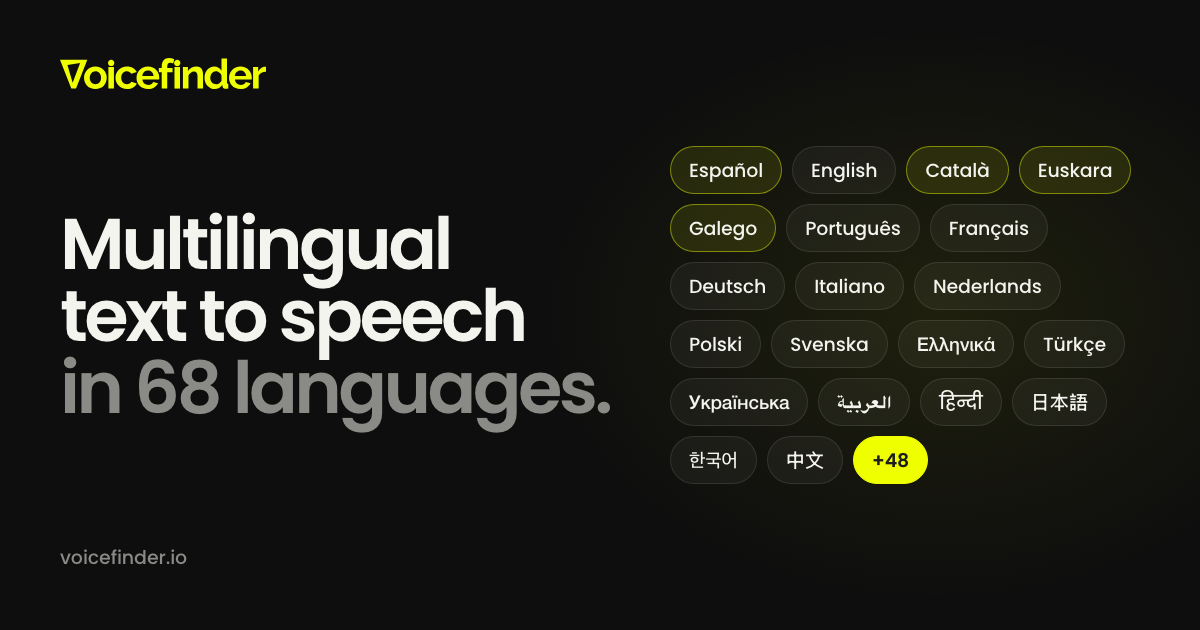
Yes. Voyager 1 speaks 55+ languages, so you can generate the translated script with a native voice or with the same voice. If the piece is already edited, AI dubbing translates it.
What format do I download?
48 kHz WAV from Basic and 48 kHz MP3 on every plan. You can download the voice alone for your own mix, or with music and effects already mixed in.